Credential tap
Civil registry binding verified through cryptographic challenge - response.
Bound
Chip-backed national identity documents bound to the civil registry - for civil registration, border control, service counter verification, and biometric holder matching. Designed for sovereign deployment, population-scale issuance, and full document lifecycle governance.
Each national identity document carries a unique NFC identity provisioned at issuance and permanently bound to the civil registration record. Officers verify in under 300 milliseconds - at border posts, service counters, and enforcement checkpoints.
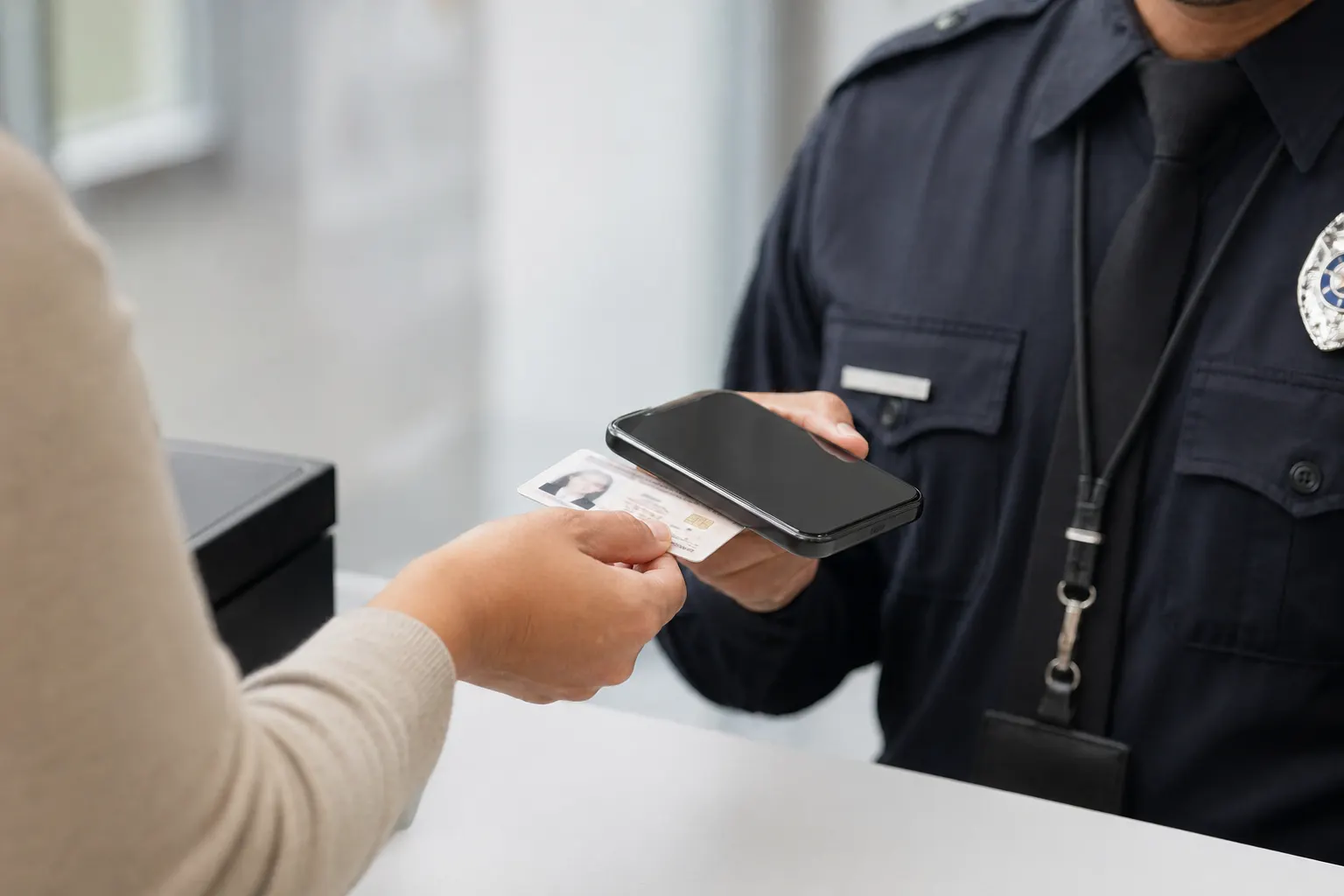
The national identity platform connects civil registration authority issuance infrastructure to field verification at border posts, government service counters, and enforcement checkpoints.
Citizen credential
National ID at the centre of the sovereign programme
Applicant biometric enrolment verified before issuance.
National ID issued and bound to the civil registration database.
Authoritative identity record under sovereign control.
NFC tap initiates cross-check with optional biometric match.
Duplicate detection, tamper checks, revocation and watchlist hooks.
Identity confirmed, mismatch flagged, or document revoked / expired.
The TrueTap identity verification response carries structured results across four independent verification dimensions. Each dimension is configurable by the programme operator based on the checkpoint context.
The chip identity matches the document's registered record. Tampered, cloned, or substituted chips are detected at this layer.
Issue date, expiry date, and programme validity rules are checked against current date and programme policy.
Where biometric integration is enabled: the holder's facial or fingerprint characteristics are compared against the enrolment record bound to the chip.
The document's current programme status is verified - including voluntary cancellation, judicial revocation, or administrative suspension.
The platform addresses the attack surfaces specific to national identity documents - from chip cloning attempts to identity substitution at issuance.
Cryptographic architecture prevents duplication of valid chips. A physical copy of the document cannot replicate the chip's challenge-response behaviour.
Biometric deduplication at enrolment prevents the same individual from obtaining multiple valid identity documents under different identities.
Chip-to-document binding means extracting a chip and re-embedding it in a different physical document produces a verifiable mismatch.
Issuance workflow controls and audit logging at the registration authority level prevent fraudulent document creation within the programme.
Fresh cryptographic challenges on each tap prevent captured NFC session data from being replayed to simulate a legitimate verification.
Revoked documents return a deterministic negative result in real time. Cached revocation data allows offline enforcement within defined staleness bounds.
Complete issuance, verification, enforcement, and administration infrastructure. Deployable within sovereign infrastructure or operated as a service by HSA, depending on programme requirements.
TrueTap verification capabilities integrated into the national authority's existing border management, civil registration, and enforcement platforms.
Verification edge deployed within the authority's infrastructure; key management and biometric data in a controlled sovereign zone. Meets data residency requirements for sensitive identity programmes.
National identity programmes operate under strict sovereignty, data residency, and constitutional constraints. TrueTap is architected for deployment within the authority's own infrastructure - not dependent on external cloud services for critical functions.
Air-gapped issuance configurations can be supported subject to programme architecture, alongside on-premise key management and data classification frameworks required by national identity law. HSA Security Solutions holds SAM.gov registration and NATO CAGE Code 3HSAW, supporting transparent engagement with allied and federal procurement processes.
The chip identity is bound to the civil registration record at issuance. Each document's validity is tied to the living civil registry - not a standalone document database.
Optional integration with border watchlist systems and national security databases enables real-time flags at border checkpoints during the verification response.
Document revocations - voluntary, judicial, or administrative - propagate to verification endpoints in real time and to offline caches within programme-defined bounds.
Government service counters and benefit systems can verify identity documents using web-based or SDK-integrated reader tools without dedicated enforcement hardware.
National identity begins at the enrolment station. Multimodal capture on fixed and mobile stations establishes each identity once - then binds it to the credential and the registry for the lifetime of the programme.
Ten-print fingerprint, controlled-lighting face and binocular iris capture - individually or combined into a single multimodal session, with operator quality-assurance feedback.
Structured demographic intake with supporting identity-document capture, OCR extraction and operator review for accurate record creation.
Biometric deduplication against the civil registry, with manual adjudication workflow for ambiguous matches and a full audit trail of identity decisions.
Fixed enrolment stations for urban centres and portable enrolment kits for remote and rural populations - synchronized to the central registry when connectivity returns.
For programmes that have selected MOSIP, enrolment, deduplication and authentication touchpoints can be delivered through MOSIP-aligned architecture and compatible enrolment and authentication devices, subject to programme specifications, applicable certifications and selected hardware configuration.
Polycarbonate national identity credentials with secure NFC inlays, laser engraving, tactile and optical security elements - personalized under controlled issuance and bound to the civil registry record.
TrueTap is not represented as MOSIP-certified. Availability of MOSIP-aligned integrations depends on the selected programme configuration, approved devices and applicable certifications.
Field verification combines credential tap and live biometric capture. Where the match happens depends on the programme architecture.
Biometric capture at the verification point is matched against the sovereign identity platform. Templates and match decisions remain inside the programme's controlled infrastructure.
Best suited to connected service counters, border posts and government offices where the sovereign registry is reachable in real time.
For selected credential architectures, a secure-card implementation performs the comparison on the credential itself, minimizing the exposure and transmission of biometric templates.
Best suited to operationally constrained environments and to programmes whose biometric governance prioritizes on-card comparison. Availability is configuration-dependent.
Civil registry binding verified through cryptographic challenge - response.
Bound
Fingerprint, face or iris captured live at the verification point.
Captured
Match resolved against the sovereign registry or a privacy-preserving secure-card architecture.
Matched
Status and policy checks return the verified / rejected / escalated verdict - logged for audit.
Authorized
Service-counter kiosks, mobile officer tablets and rugged handhelds extend verification beyond the central office - into service centres, border posts and the field.
Self-service kiosks for high-throughput citizen identity verification.
Officer-operated service-counter terminals with NFC and biometric capture.
Field-grade readers for border, enforcement and remote verification.
Officer tablets with offline-first verification and synchronized logging.
Centralized card personalization linked to enrolment and registry records.
Combined credential tap and biometric confirmation devices.
National identity is not a one-time issuance - it is a multi-decade governance commitment. TrueTap supports the full lifecycle under sovereign control.
Population capture under sovereign control.
Biometric uniqueness before issuance.
Credential bound to the civil registry.
Field and institutional verification events.
Lifecycle renewal and re-issuance.
Suspension, revocation, status and audit.
Biometric templates, match decisions and lifecycle operations are governed by the programme's sovereign architecture. HSM-backed key operations, role-based access and encrypted biometric transport are deployed to match national data-residency and constitutional requirements.
National identity programmes require a structured engagement process. Contact TrueTap to begin the scoping conversation with your authority's requirements, legal framework, and deployment constraints.